

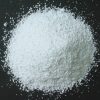
Sodium acetate, NaCH3COO, also abbreviated NaOAc is the sodium salt of acetic acid. This colorless deliquescent salt has a wide range of uses.
Sodium acetate salt, or simply sodium acetate, has many practical uses. It is the conjugate base of a weak acid, meaning that it only partially ionizes when dissolved in water. This provides sodium acetate with buffering properties, that is the ability to maintain solutions at a relatively constant pH despite acid or base challenges. This property along with its low toxicity, helps explain why sodium acetate can be found in industries ranging from petroleum production to food flavoring.
properties
|
Chemical formula
|
C2H3NaO2 |
| Molar mass | 82.034 g·mol−1 |
| Appearance | White deliquescent powder |
| Odor | Vinegar (acetic acid) odor when heated to decomposition |
| Density | 1.528 g/cm3 (20 °C, anhydrous) 1.45 g/cm3 (20 °C, trihydrate) |
| Melting point | 324 °C (615 °F; 597 K) (anhydrous) 58 °C (136 °F; 331 K) (trihydrate) |
| Boiling point | 881.4 °C (1,618.5 °F; 1,154.5 K) (anhydrous) 122 °C (252 °F; 395 K) (trihydrate) decomposes |
|
Solubility in water
|
123.3 g/100 mL (20 °C) |
| Solubility | Soluble in alcohol, hydrazine, SO2 |
| Structure | 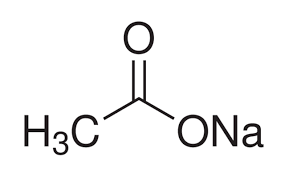 |
Applications
Biotechnological
Sodium acetate is used as the carbon source for culturing bacteria. Sodium acetate is also useful for increasing yields of DNA isolation by ethanol precipitation.
Industrial
Sodium acetate is used in the textile industry to neutralize sulfuric acid waste streams and also as a photoresist while using aniline dyes. It is also a pickling agent in chrome tanning and helps to impede vulcanization of chloroprene in synthetic rubber production. In processing cotton for disposable cotton pads, sodium acetate is used to eliminate the buildup of static electricity.
Concrete longevity
Sodium acetate is used to mitigate water damage to concrete by acting as a concrete sealant, while also being environmentally benign and cheaper than the commonly used epoxy alternative for sealing concrete against water permeation
Food
Sodium acetate may be added to food as a seasoning, sometimes in the form of sodium diacetate, a one-to-one complex of sodium acetate and acetic acid, given the E-number E262. It is often used to give potato chips a salt and vinegar flavor. Sodium acetate (anhydrous) is widely used as a shelf-life extending agent, pH control agent[ It is safe to eat at low concentration.

Buffer solution
A solution of sodium acetate (a basic salt of acetic acid) and acetic acid can act as a buffer to keep a relatively constant pH level. This is useful especially in biochemical applications where reactions are pH-dependent in a mildly acidic range (pH 4–6).
Preparation
For laboratory use, sodium acetate is inexpensive and usually purchased instead of being synthesized. It is sometimes produced in a laboratory experiment by the reaction of acetic acid, commonly in the 5–8% solution known as vinegar, with sodium carbonate (“washing soda”), sodium bicarbonate (“baking soda”), or sodium hydroxide (“lye”, or “caustic soda”). Any of these reactions produce sodium acetate and water. When a sodium and carbonate ion-containing compound is used as the reactant, the carbonate anion from sodium bicarbonate or carbonate, reacts with hydrogen from the carboxyl group (-COOH) in acetic acid, forming carbonic acid. Carbonic acid readily decomposes under normal conditions into gaseous carbon dioxide and water. This is the reaction taking place in the well-known “volcano” that occurs when the household products, baking soda and vinegar, are combined.
CH3COOH + NaHCO3 → CH3COONa + H2CO
H2CO3 → CO2 + H2O
Industrially, sodium acetate trihydrate is prepared by reacting acetic acid with sodium hydroxide using water as the solvent.
CH3COOH + NaOH → CH3COONa + H2O
Homemade Sodium Acetate
Sodium acetate can be made with the common household ingredients baking soda and vinegar. Wear safety goggles as the splashing of solutions into your eyes can be irritating. Baking soda or sodium bicarbonate and vinegar or acetic acid react to form sodium acetate along with carbon dioxide and water. To begin the reaction, add one heaping spoonful of baking soda to a glass container. Slowly add vinegar, being careful not to create too much foam. Keep adding vinegar while stirring the mixture. Once the mixture stops bubbling, you can stop adding vinegar as all of the sodium bicarbonate has converted to sodium acetate, carbon dioxide — which are the bubbles you saw — and water. To separate out the sodium acetate from the water, boil the solution until you hear a sizzling and popping sound. At this point, if you blow across the top of the surface, crystals will form. When you get this super-saturated sodium acetate solution, cool the solution to room temperature; it will form a translucent gel. Scrape the gel into a bowl lined with a coffee filter, which will absorb any remaining water. Break up the pieces with the back of a spoon and put them on another coffee filter to finish the drying process, creating sodium acetate powder.
Reactions
Sodium acetate can be used to form an ester with an alkyl halide such as bromoethane:
CH3COONa + BrCH2CH3 → CH3COOCH2CH3 + NaBr
Sodium acetate undergoes decarboxylation to form methane (CH4) under forcing conditions (pyrolysis in the presence of sodium hydroxide):
CH3COONa + NaOH → CH4 + Na2CO3
Calcium oxide is the typical catalyst used for this reaction. Caesium salts also catalyze this reaction
Safety
The safety of sodium acetate has been studied extensively in rat and mouse animal models. When given orally, the lethal dose that will kill half a population of rats is 3530mg of sodium acetate per kg of rat body weight. If inhaled rather than ingested, the dose required to kill half the rat population is much higher, over 30 g/m3 per hour. In mice, a subcutaneous or under the skin injection of 3200mg/kg of body weight will kill half of a mouse population, similar to the ingestion of sodium acetate in rats. However, orally mice can withstand much more than rats; the lethal dose for half the population of mice being 6891mg/kg of body weight. In humans, inhalation of sodium acetate may cause a cough and sore throat. Direct skin or eye contact may cause redness and irritation. However, overall, toxicity in humans is minimal.
Be the first to review “Sodium acetate”
Related products

Uncategorized

Uncategorized

Uncategorized

Uncategorized

Uncategorized

Uncategorized

Uncategorized

Uncategorized
Reviews
There are no reviews yet.