
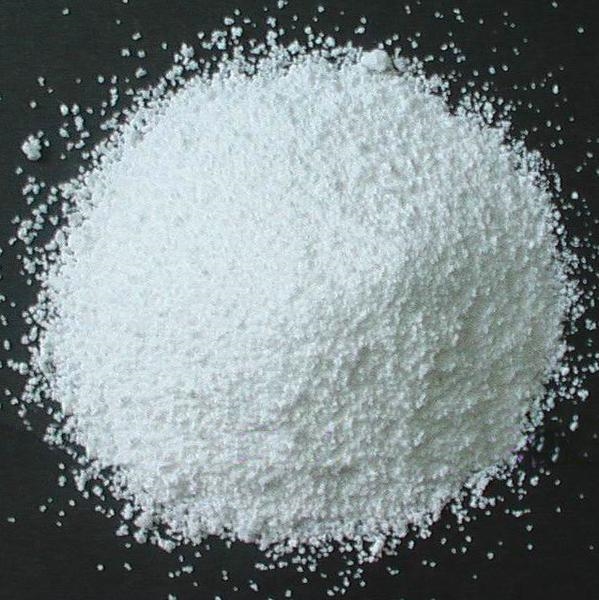

Potassium carbonate is the inorganic compound that is a white salt and soluble in water. It is deliquescent, often appearing as a damp or wet solid and also known as Dipotassium carbonate, Carbonate of potash, Carbonic acid and, dipotassium salt.
Properties
| Chemical formula | K2CO3 |
| Molar mass | 138.205 g/cm3 |
| Density | 2.43 g/cm3 |
| Melting point | 891 ͦ C |
| Boiling point | decomposes |
| pH | 11.6 (aqueous solution) |
| Odor | odorless |
| Taste | Alkaline taste |
| chemical structure | 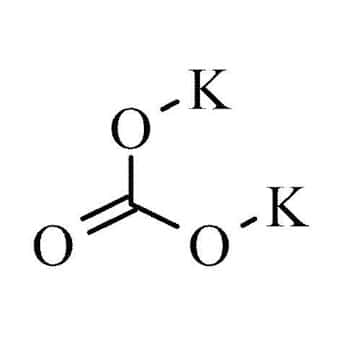 |
Production
Potassium carbonate is prepared commercially by the reaction potassium hydroxide with carbon dioxide:
2 KOH + CO2 → K2CO3 + H2O
From the solution crystallizes the sesquihydrate K2CO3·3⁄2H2O (“potash hydrate”). Heating this solid above 200 °C gives the anhydrous salt. Alternative method, potassium chloride is treated with carbon dioxide in the presence of an organic amine to give potassium bicarbonate, which is then calcined:
2 KHCO3 → K2CO3 + H2O + CO2
Applications
Potassium carbonate is a water-soluble salt with its main applications in the production of glass, detergents (soaps), ceramics, fertilizers, agrochemicals, pharmaceuticals, food, feed, fire extinguisher, drying agent for solvents and etc.
Potassium carbonate can be divided into heavy and light types if from density and solubility. The heavy type is mainly used in the fields of glass, ceramics, and fertilizers, while the light potassium carbonate is mainly applied in the fields of food, pharmaceuticals, and agrochemicals.
Food
Its food grade is mainly used as an acidity regulator and its common food uses as follows:
- Cocoa: it can be used in the manufacturing of alkalized cocoa to reduce the acidity of natural cocoa beans and darken cocoa powder.
- Wine: it can also be used as a buffering agent to lower acidity during wine production.
- Bakery: it was commonly used as a leavening agent to rise bread in baking but later replaced by sodium bicarbonate due to the bitter aftertaste. But can be used as a substitute of sodium bicarbonate in baked goods where low sodium content is desired.
- Ramen Noodles: the main ingredient in Kansui, which is used to improve texture and color.
- Marinades: as a buffering agent in marinades for meat.
- Milk powder: an acidity regulator in milk and cream powders.
- Raisins: as a drying agent for turning grapes into raisins.

Ceramics
Potassium carbonate can be used as a raw material for ceramic frit in ceramic production. Its main purpose is to lower the frit melting temperature and increase the value of the frit expansion coefficient. It exists as K2O in the frits and commonly used in titanium dioxide frits for the appliance industry.
Soap
It can be used to make soap softer than sodium based soaps.
Glass
It was reported by the top USA manufacturer Armand that more than 44% of the total consumption of potassium carbonate is in glass production, which improves glass transparency, electrical resistivity, strength and refractive index. It is a source of K2O for alkali barium, lead or strontium silica glasses which are used in television tubes, laboratory glass, optical glass and etc.

Dangers
FDA considers this substance safe when used in foods but in laboratory and factory in can cause some symptoms.
CONTACT WITH SKIN
In this situation potassium carbonate causes irritation, particularly after prolonged exposure.
CONTACT WITH EYES
Potassium carbonate is highly irritant to the eyes and associated mucous membranes. In case of prolonged exposure, it may cause permanent corneal damage, including loss of vision.
INGESTION
If ingested, potassium carbonate causes irritation in the gastrointestinal tract, resulting in burns to the lips, tongue, mouth, oesophagus or even stomach. This causes vomiting and nausea, intense abdominal pain and, in extreme cases, difficulty breathing due to swollen glottis, or collapse due to a drastic drop in the blood pressure. If swallowed, it may help to give the patient water or milk, unless in case of vomiting, convulsions or the patient is unconscious.
INHALATION
Patients that inhale large quantities of potassium carbonate may experience coughing, difficulty breathing and chest pains. This is caused by irritation of the respiratory tract and its mucous membranes.
PERSONAL PROTECTION
Operators must be aware of risks associated with handling this chemical and use appropriate personal protection equipment. As this is an extremely fine powder, ventilation is essential to maintain airborne levels under control. Furthermore, when using sodium carbonate, operator must use a lab coat, goggles and gloves, to avoid any direct contact with skin and eyes and prevent inhalation. In cases of large spills, a full-suit and a self-contained breathing apparatus may be required for the clean-up.
References:
https://en.wikipedia.org/
https://byjus.com/
https://pubchem.ncbi.nlm.nih.gov/
https://www.vynova-group.com/
https://foodadditives.net/
http://www.enablingtechnology.eu/
https://digitalfire.com/
Be the first to review “Potassium carbonate”
Related products

Uncategorized

Uncategorized

Uncategorized

Uncategorized

Uncategorized

Uncategorized

Uncategorized

Uncategorized
Reviews
There are no reviews yet.